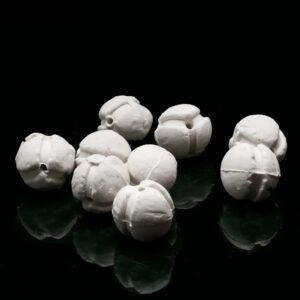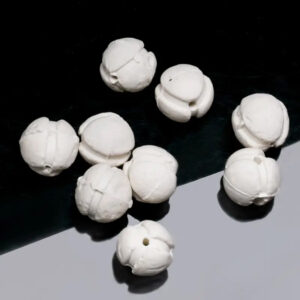
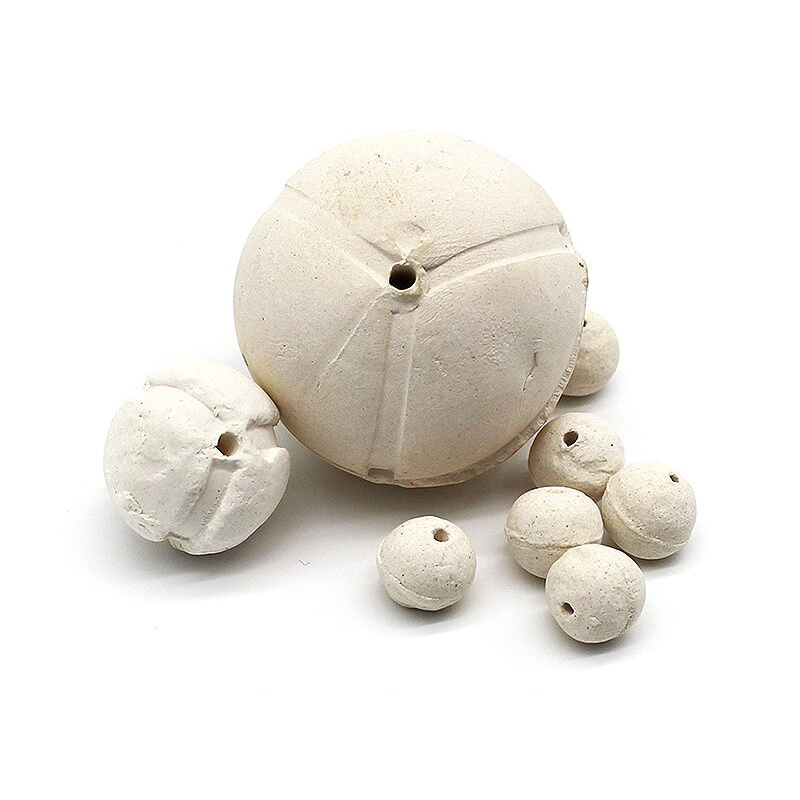
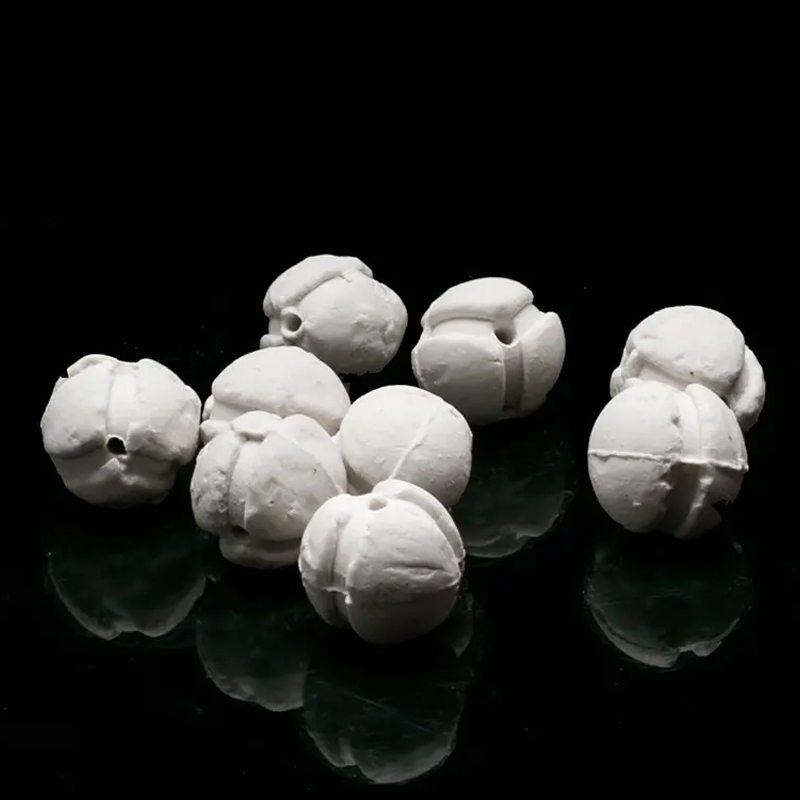
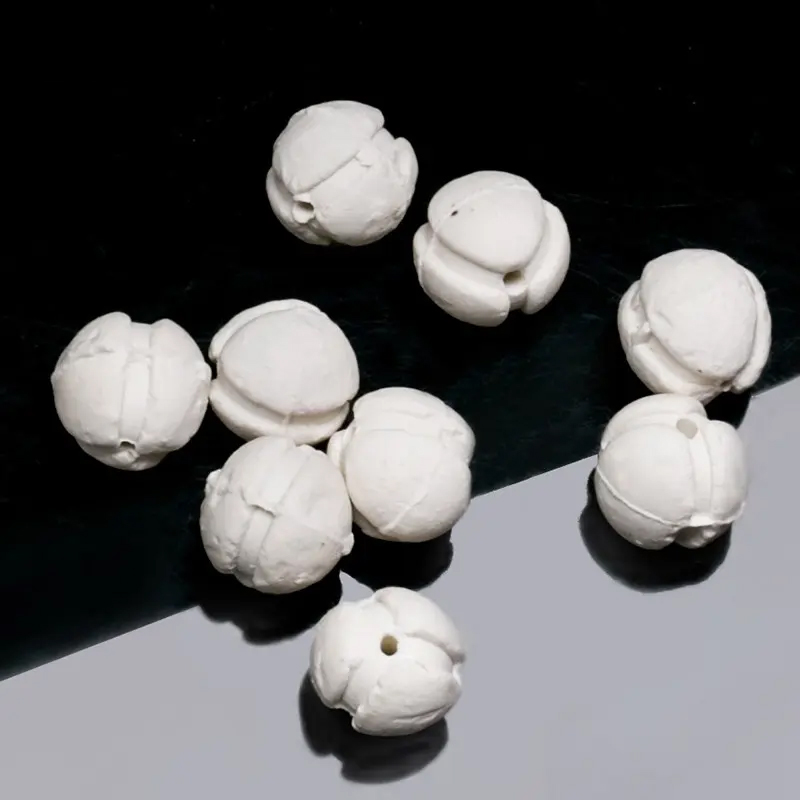
Pores are mostly through-hole (open porosity typically 30%-70%), with adjustable pore size (micrometer to millimeter scale). Pores are interconnected, forming a well-developed channel network, significantly increasing the specific surface area (typically 10-100 m²/g).
Inheriting the properties of ceramic materials, they can withstand high temperatures (up to 1600°C, depending on the material), corrosion from strong acids and alkalis (for example, alumina ceramic balls are resistant to most non-hydrofluoric acid media, while silicon carbide is resistant to strong corrosion), and are unreactive with most chemicals.
While the porous structure results in lower compressive strength than solid ceramic balls, it still surpasses most organic porous materials (such as plastic foam) and can withstand a certain load (compressive strength is typically 5-50 MPa).
The porous structure results in a density that is only 1/3-1/2 that of solid ceramic (approximately 1.0-2.5 g/cm³). Gases and liquids can penetrate the pores efficiently, resulting in excellent fluidity.
| Item | Feldspar | Feldspar-Mola | Molai Stone | Molai-Corundum | Corundum | |
| Al,O.(%) | 20-30 | 30-45 | 45-70 | 70-90 | 290 | |
| Water Adsorption (%) | ≤5 | ≤5 | ≤5 | ≤5 | ≤5 | |
| Acid Resistance (%) | ≥98 | 298 | ≥98 | 298 | ≥98 | |
| Alkaki Resistance (%) | ≥80 | ≥82 | ≥85 | ≥90 | ≥95 | |
| Operation Temp max(℃) | ≥1300 | ≥1400 | ≥1500 | ≥160r | ≥1700 | |
| Rlk Densit (kg/m3) | 1100-1200 | 1200-1300 | 1300-1400 | 1400-1500 | ≥1500 | |
Porous structures are achieved by adding pore-forming agents (such as organic particles or carbon powder) or by physical foaming.
Pore-forming agent method: Volatile/combustible organic particles (such as starch or plastic balls) are mixed into the mold during molding. The pore-forming agent decomposes during sintering, leaving pores.
Foam impregnation method: Ceramic slurry is impregnated into a polymer foam skeleton. After sintering, the foam burns away, forming a porous ceramic with a foam-like structure.
Gelcasting method: Pore formation is controlled through chemical reactions, resulting in higher precision and suitable for complex shapes.